

Mediation in Indian commercial disputes is in the midst of a transformation. From being dismissed as a “soft option,” it has become a statutory process under the Mediation Act, 2023, promising a faster, more confidential route to dispute resolution and the preservation of valuable business relationships. This detailed article explores India’s evolving mediation landscape: legal underpinnings, practical challenges, key precedents, the institutional ecosystem, and best practices for future-ready dispute resolution.
Historic Evolution and Legal Underpinnings
Traditionally, Indian commercial disputes were routed to the courts—a process marked by serious delays—or to costly arbitration. The turning point came with the Commercial Courts Act, 2015, and its Section 12A, introducing pre-institution mediation as mandatory, except where urgent interim relief is required. This legal move was prompted by both Supreme Court encouragement (Afcons Infrastructure Ltd. v. Cherian Varkey, 2010) and the realization that businesses needed faster, more amicable solutions.
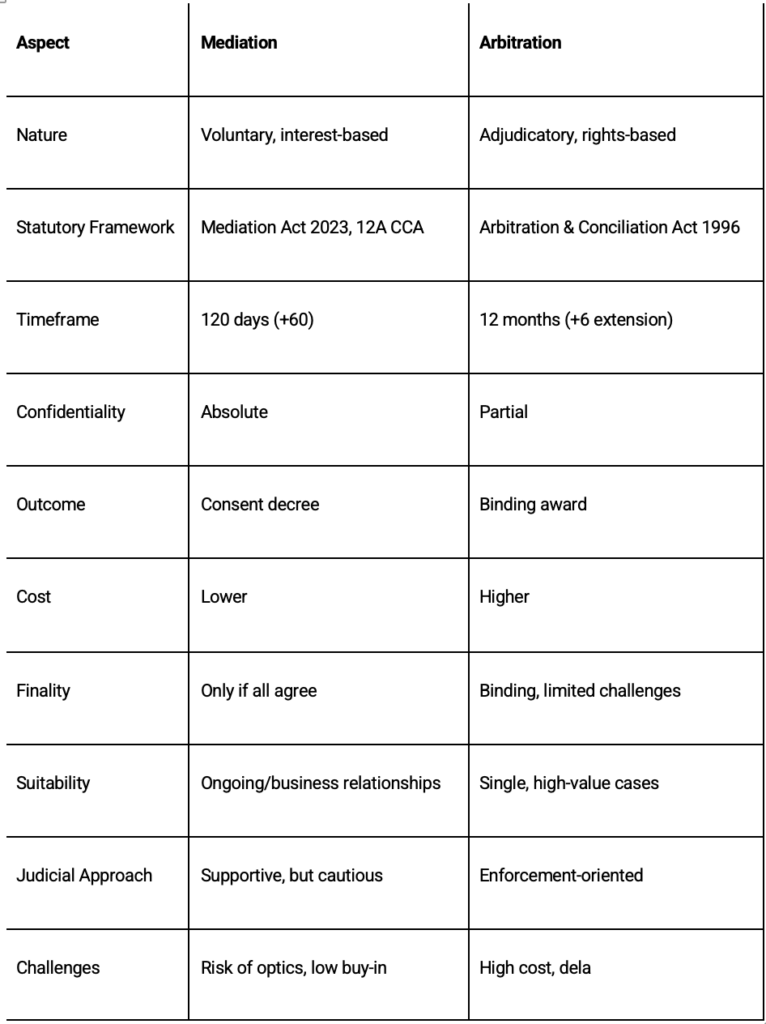
Further momentum came with the Mediation Act, 2023, which formally sets a 120-day window for completion, with a 60-day extension, and makes mediated settlements enforceable as civil court decrees under Section 27. Hybrid frameworks (Med-Arb, Arb-Med-Arb), already successful in Singapore and Hong Kong, are being adopted by new Indian institutions like IAMC Hyderabad and MCIA, broadening the toolkit for Indian businesses.
Major Judicial Interventions and Precedents
● Afcons Infrastructure Ltd. v. Cherian Varkey (2010): The Supreme Court urged courts to promote mediation, especially in commercial cases, recognizing its ability to reduce burdens and foster lasting settlements.
● Patil Automation Pvt. Ltd. v. Rakheja Engineers Pvt. Ltd. (2022): Clarified the mandatory nature of pre-litigation mediation under Section 12A, declaring suits filed without mandatorily attempting mediation as non-maintainable.
● Salem Bar Association II (2005): Confirmed the necessity for courts to consider alternative dispute resolution (ADR) processes, including mediation, to alleviate docket explosions.
Key Statutory Features and Process
● Mediation Act, 2023: Institutionalizes mediation, introduces enforceability, and strengthens mediator codes.
● Commercial Courts Act, 2015, Section 12A: Mandates pre-suit mediation for commercial disputes, subject to limited exceptions.
● Arbitration & Conciliation Act, 1996: Mediation is frequently included as a step in multi-tiered dispute resolution clauses, embedding negotiation and mediation before arbitration begins.
The Comparative Lens: Mediation vs. Arbitration
Institutional Framework and Capacity Challenges
India’s mediation ecosystem has grown with the rise of mediation centres like IAMC Hyderabad and MCIA Mumbai, often modelling themselves on successful international frameworks. However, the spread is uneven, with significant institutional and human resource gaps persisting outside Tier 1 metros. Trained mediators, professional standards, and digital infrastructure remain areas of concern. Mediation will succeed only if corporate buy-in, institutional credibility, and mediator competence converge nationwide.
Practical Obstacles and Red Flags
● “Tick Box” Risk: Section 12A of the Commercial Courts Act, while well-intentioned, sometimes degenerates into formality. Litigants may treat it as a compliance checkbox rather than a real opportunity for early settlement.
● Resource Scarcity: The shortage of experienced mediators and institutional bodies outside major metros slows down real adoption and erodes confidence in the process.
● Varied Buy-in: The quality of mediation often depends on the engagement and good faith of the parties, with “forced mediation” rarely succeeding in adversarial environments.
● Sectoral Constraints: Certain sectors, like infrastructure, JV/franchise, and long-term supply contracts, benefit greatly from mediation’s relational approach, while others may require binding adjudicatory processes due to their contentious or high-stakes nature.
Successes, Sectoral Insights, and Hybrid Approaches
Where parties act in good faith and mediators are skilled, mediation consistently produces better outcomes for ongoing business relationships, speedy dispute closure, and cost savings. Hybrid approaches, embedding mediation between negotiation and arbitration, optimize process flexibility and enforceability, providing a tiered safety net well-suited to Indian commercial practice.
The Road Ahead: Recommendations
- Strengthen Institutional Capacity: Invest in developing regional mediation centres and standardized training programs for mediators.
- Cultural Shift: Promote business and legal community buy-in to reposition mediation as the first and best step in dispute resolution.
- Mandate with Meaning: Ensure Section 12A compliance is substantive, not mere paperwork, by encouraging courts to scrutinize mediation efforts for good faith participation.
- Hybrid Models: Promote escalation clauses (negotiation → mediation → arbitration) in commercial contracts to blend cost-effective settlement with the certainty of arbitration as a fallback.
- Data and Feedback: Develop robust feedback loops and open data on success rates, sector-specific experiences, and best practices to inform ongoing legal reform.
India’s ambitious legislative and institutional overhaul aims to unlock the true transformative value of mediation in commercial disputes. Provided buy-in, infrastructure, and professionalization keep pace, mediation is positioned not as a gimmick, but as a genuine gamechanger in dispute resolution for a new business era.